


How does this tool work?
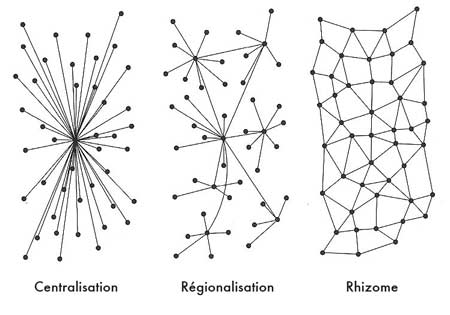
Optimize your research by finding problems or concepts in the works
It’s very simple
It works like a database for an archive or library. Simply enter the word you are looking for in the search engine (see list of concepts and issues in the database) and select the works or editions (French/English/Portuguese/Spanish) you wish to consult. The results will show you: the pages where the word appears in the selected work (consult the list of editions we have consulted, as some works have more than one edition), relevant notes on the concept/issue (e.g., translation errors or clarifications, conceptual variations from one work to another, etc.), notable quotations, related concepts that indicate to the researcher a search path to complete the information on their previous search.
Classification Criteria
The same word may appear in different forms throughout the work (e.g., Prague Circle, Prague School/fast, faster, fasting/creation, creative function, create). Therefore, we consider all these variations in our search. Although these variations may appear when you type only one of them, it is possible that when you go to the pages you will still find the word in other variations that we decided to omit from the list, such as conjugated verbs, the word in the feminine or plural form. All pages were considered and are registered, even if these minor variations are not included in the search engine and list.
Regarding related concepts: of course, almost everything can be related in the philosophy of Deleuze and Guattari; that is precisely the rhizomatic logic of their thinking. The concepts that we highlight as related are concepts that refer to almost the same thing or are directly linked in the text. (e.g., the concept of collective and that of people and community). As with any classification plan in a file, the criteria are somewhat arbitrary, and therefore we try to group words that are not the same but that serve almost as synonyms in the text (e.g., comedy, humor, laughter) and separate and group others as related concepts (e.g., joyful and joy, since in Deleuze’s work this becomes a concept—Spinoza, joyful affect—different from the idea of humor, comedy).
The researcher must have the works in their possession; we do not provide the works or access to them.
Some works have more than one edition; we have decided to use those that are either the most widely used or available in PDF format with the pagination of the printed book. Although there are ebook versions and digitized editions with pagination different from the printed works, we have chosen to use the printed works as a reference (many of them with PDF versions with the same pagination as the physical book).
Proper names are inserted by surname, first name (e.g., Foucault, Michel).
Editions Used
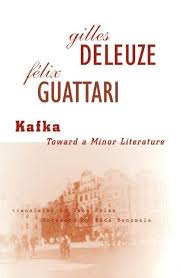
english
Kafka: Toward a minor literature
Translation by Dana Polan
University of Minnesota Press. First edition 1986/Seventh printing 2003
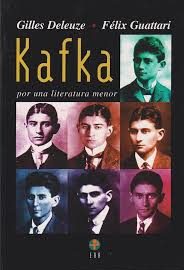
spanish
Kafka: Por una literatura menor
Ediciones Era. Primera edición 1978/Quinta reimpresión 2008

portuguese
Kafka: Para uma literatura menor
Assírio & Alvim [Portugal]. Edição 0789, setembro 2003
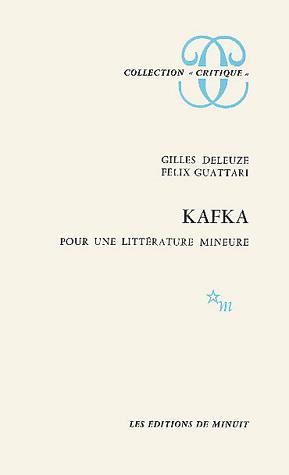
french
Kafka: Pour une littérature mineure
Les éditions de minuit. 1975
Concept List
If you want to see all the concepts we have already uploaded to our database click below: